Solar canopies act like massive, rigid sails catching unpredictable winds. Because of this dynamic, the solar carport foundation is the structural linchpin of your entire system. If a foundation fails, it causes catastrophic structural collapse. It can also lead to severe project delays and massive budget overruns. Commercial property owners and Engineering, Procurement, and Construction (EPC) firms face a critical choice. They must decide between traditional concrete footings and helical screw piles.
Making the wrong choice leads to wasted resources. It also severely disrupts active retail parking facilities. This guide provides an evidence-based framework. It helps you evaluate both foundation types reliably. We base this evaluation on actual geotechnical realities. We also analyze strict installation timelines and site-specific needs. You will learn how soil composition, load dynamics, and installation speeds dictate your best path forward. Understanding these factors ensures your canopy remains stable. It guarantees your installation is secure and highly efficient.
Key Takeaways
Geotechnical dependence: Soil composition (sand, clay, bedrock) and water table levels strictly dictate foundation viability; no single foundation type works everywhere.
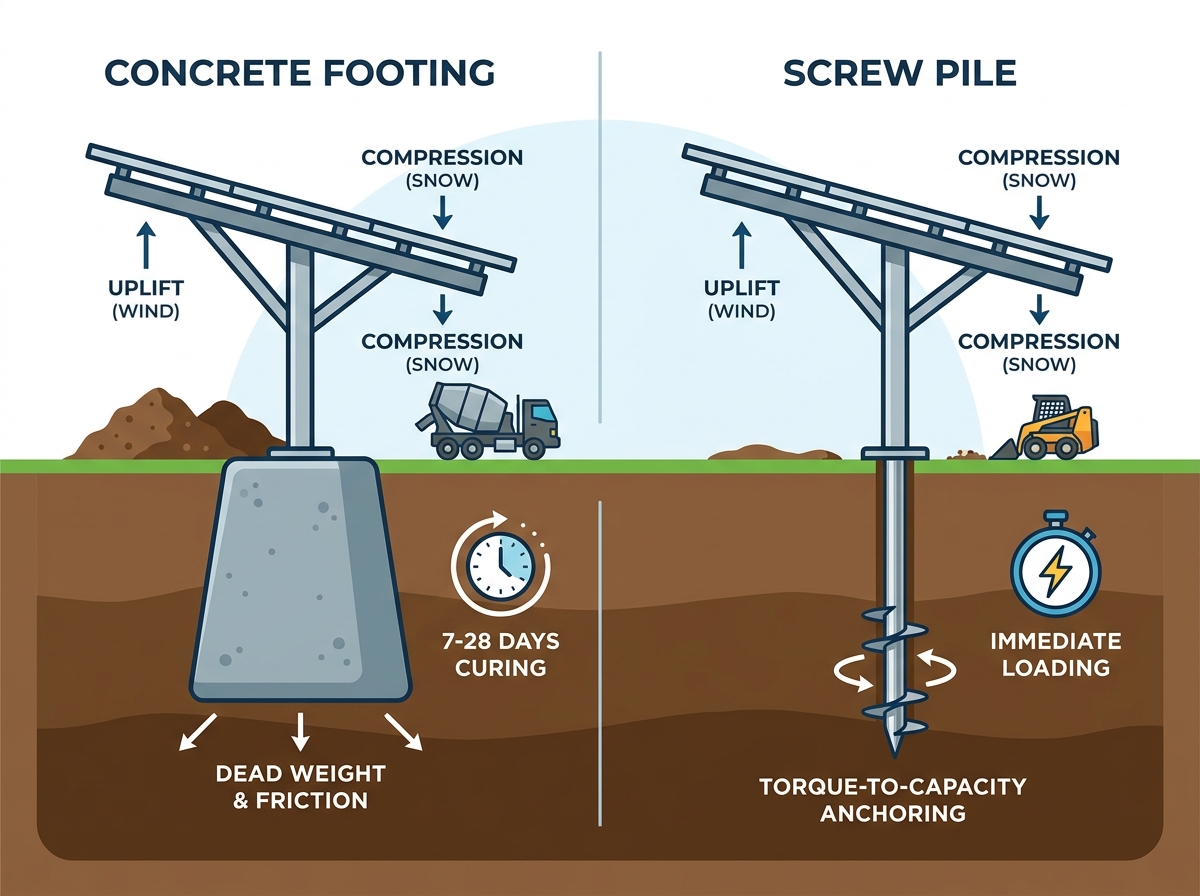
Load dynamics: Carports require massive resistance to uplift (wind) and compression (snow). Concrete relies on dead weight and friction; screw piles rely on torque-to-capacity anchoring.
Installation speed: Screw piles can shave weeks off project timelines by eliminating curing periods and reducing spoils removal, but they risk refusal in rocky soils.
Total Cost of Ownership (TCO): While concrete materials may appear cheaper, the labor, site disruption to active parking lots, and heavy machinery costs often make screw piles more economically viable for specific commercial deployments.
The Engineering Realities of Solar Carport Foundation Design
Engineering solar parking structures involves complex physics. Ground-mount solar farms sit close to the earth. Carports stand highly elevated above vehicles. This significant elevation creates extreme wind shear. It generates massive uplift potential during severe storms. The structural columns experience intense moment (bending) forces at the base. You need robust solar carport foundation design to resist these extreme forces safely. High winds try to rip the entire structure upward. Heavy winter snow pushes it aggressively downward. The foundation must counter both extremes continuously.
Without proper anchors, these massive structures become liabilities. Wind behaves unpredictably in open parking lots. It funnels between nearby buildings. It accelerates under the canopy roof. This tunneling effect multiplies uplift forces exponentially. Any credible foundation decision requires accurate field data. It begins by obtaining a localized geotechnical report. Engineers drill deep soil borings to analyze underground layers. You cannot guess soil composition accurately. Engineers look at sand, clay, or bedrock profiles. They carefully measure seasonal water table levels. These underground variables strictly dictate which foundation works best. Ignoring this data leads to disastrous failures.
Several risk factors compromise long-term foundation integrity. Frost heave poses severe threats in northern climates. Freezing ground expands powerfully. It pushes weak foundations upward over time. Corrosive soils degrade steel and concrete silently. High water tables destabilize the surrounding earth quickly. You must address these vital E-E-A-T considerations early. Certified structural engineers apply standard frameworks like the International Building Code (IBC). They ensure structures withstand local environmental stressors effectively.
Best Practice: Always commission a site-specific geotechnical report before ordering steel materials.
Common Mistake: Relying on outdated soil data from a nearby building project.
Solar Panel Concrete Foundation: The Traditional Approach
A solar panel concrete foundation represents the industry’s reliable legacy approach. Contractors install deep drilled shafts (caissons) or broad spread footings. They rely heavily on massive physical weight. They utilize surface friction against the surrounding soil. This immense mass counteracts violent structural uplift efficiently. It also resists powerful lateral loads perfectly. Engineers have used this proven method successfully for decades.
Primary Advantages (The "Why"):
Unmatched compressive strength supports massive steel superstructures easily. Heavy canopies transfer extreme loads straight downward.
High versatility handles mixed, unpredictable, or highly rocky soil conditions well. Heavy drilling equipment and wet concrete easily overcome most underground obstructions.
Universal acceptance means all local building codes and inspectors approve them readily. Code enforcement officers understand concrete standards completely.
Inspectors know exactly what to look for during concrete pours. They verify rebar cages quickly. They check cement slump tests easily. This familiarity speeds up the municipal permitting process significantly. However, you must schedule these municipal inspections carefully.
Implementation Risks & Downsides:
Time & Weather: Concrete requires 7 to 28 days of curing time. Steel erection cannot begin until the concrete hardens fully. Heavy rain and freezing temperatures halt cement pours completely. You lose valuable construction days easily.
Site Disruption: Heavy cement trucks and large augers cause severe disruption. They block driving lanes in active commercial parking lots. They damage existing asphalt surfaces frequently.
Spoils Management: Deep drilling generates massive amounts of displaced dirt. Crews must haul away these messy spoils. This removal process adds hidden trucking fees. It also requires specific environmental disposal plans.
Solar Carport Screw Pile Foundation: The High-Speed Alternative
Helical piles present a modern, highly efficient engineering solution. Contractors screw these threaded steel pillars deeply into the earth. They drive them until reaching dense, load-bearing soil strata. A solar carport screw pile foundation uses mechanical soil disturbance. It anchors firmly instead of relying on sheer mass. The helical plates act like massive screws holding the earth securely.
They operate quietly compared to diesel augers. Businesses can stay open safely. Customers hardly notice the construction activity. The torque motors measure soil resistance continuously. If a pile reaches required torque early, engineers can approve it instantly. You save tremendous time on site.
Primary Advantages (The "Why"):
Immediate Loading: Helical piles require absolutely zero curing time. Crews can erect the heavy steel framing the exact same day. This accelerates project completion times massively.
Minimal Disruption: Contractors install them using compact equipment like skid steers. This causes virtually zero dirt spoils. Parking lanes remain open during active installation. Retail businesses avoid frustrating their loyal customers.
Measurable Capacity: Installation torque correlates directly to load-bearing capacity. Engineers receive instant, verifiable capacity data during the drive process. They know exactly when the pile reaches required strength.
Implementation Risks & Downsides:
Refusal Risks: Piles experience a high failure rate in solid bedrock. Heavy cobble or dense underground debris stops penetration completely. When a pile refuses, contractors must extract it immediately. Urban parking lots often hide old building foundations. These hidden obstacles cause sudden refusal.
Lateral Load Limitations: Tall carports generate massive lateral stress during high winds. Standard piles might need additional structural bracing. Engineers often specify larger pipe diameters. They do this to handle extreme horizontal forces safely. Standard ground mounts do not face this specific issue.
Head-to-Head Evaluation: Evaluating Ground Mounting Foundation Options
Comparing these structural systems requires looking beyond raw material prices alone. You must evaluate the true installed project timelines comprehensively. When comparing ground mounting foundation options, concrete initially looks cheaper. However, concrete demands extremely high labor hours. It causes extensive scheduling delays. It also requires expensive post-installation site cleanup. Screw piles use highly engineered, premium hardware. They definitely cost more upfront per unit. Yet, they drastically reduce expensive labor hours. They shorten lengthy project timelines significantly. You achieve operational status much faster.
You must calculate the hidden cost of lost business. If a retail store loses fifty parking spots for a month, revenue drops. Concrete causes this extended disruption. Screw piles might return those critical parking spots in three days. We must also view this choice through strict environmental and compliance lenses. Corporate ESG goals demand lower emissions today. Concrete carries a notoriously heavy carbon footprint. Cement production generates massive greenhouse gas emissions globally. At the end of its useful life, concrete requires heavy demolition. Large chunks end up filling local landfills permanently.
Conversely, screw piles offer extreme sustainability benefits. Crews can simply unscrew them from the ground. The extracted steel is easily reused elsewhere. It can also be fully recycled into new products. You protect the environment twice.
Your specific site location heavily influences the final engineering decision. Greenfield sites and raw land projects often favor concrete heavily. This holds especially true if the soil contains heavy rock layers. Large-scale screw pile deployment works beautifully in clean, rock-free agricultural soil. Active retail and corporate parking lots require a completely different approach. These commercial sites heavily favor helical screw piles. Fast installation minimizes daily lot downtime. It prevents serious business interruption and lost retail revenue.
Foundation Comparison Matrix
Feature
Concrete Footings
Screw Piles
Installation Speed
Slow (7-28 days curing)
Fast (Immediate loading)
Site Disruption
High (Heavy machinery, spoils)
Low (Compact equipment)
Soil Adaptability
Excellent in rocky conditions
Prone to refusal in bedrock
Environmental Impact
High carbon footprint
Low, easily recyclable
Implementation Next Steps and Shortlisting Logic
Moving forward requires a strict, logical engineering process. You must eliminate dangerous guesswork entirely. Securing reliable solar parking canopy footings demands rigorous field testing. Rushing this specific phase guarantees expensive structural failures later.
Commission the Geo-Report: Never trust assumed or historical soil conditions. Hire a licensed geotechnical engineer to drill physical test bores. Accurate soil data prevents catastrophic installation failures later. It defines your exact engineering parameters clearly.
Conduct Pull-Testing: Insist on on-site pull and load testing. Do this before ordering massive bulk materials. This physical test verifies the exact torque-to-capacity ratio. It proves screw piles will work on your specific site safely.
Align with your EPC: Ensure the chosen contractor possesses verified field experience. They must understand your specific foundation type deeply. They need specialized torque-monitoring equipment for installing helical piles securely. Verify their past successful commercial carport projects.
Conclusion
Selecting the correct foundation acts as an essential risk mitigation strategy. You protect your structural integrity and project schedule simultaneously. Your final decision should combine accurate geotechnical data with practical site constraints. Consider parking lot downtime sensitivity carefully. Factor in strict overall project timeline requirements. Do not base your choice solely on upfront raw material costs. Ignoring site realities leads to schedule overruns and budget bloat.
Evaluate site soil profiles through physical bore testing immediately.
Assess the maximum allowable downtime for your commercial parking facility.
Determine if severe weather will threaten a traditional concrete curing schedule.
Verify your installation contractor has proper equipment for your chosen method.
Prioritize long-term structural safety over short-term material savings.
FAQ
Q: Can screw piles support commercial-scale solar canopies?
A: Yes, they absolutely can. Engineers must specify the correct pipe diameter and wall thickness. They configure the helical plates for the specific uplift forces. They calculate lateral loads of your canopy structure carefully. Proper engineering ensures total structural stability.
Q: How long does a concrete foundation take to cure before erecting the carport?
A: Typically, concrete needs to reach 75% of its design strength before bearing loads. This process takes 7 to 14 days minimum. Weather conditions and specific mix designs alter this timeline. Cold weather delays steel erection significantly.
Q: What happens if a screw pile hits rock during installation?
A: This situation is called "refusal." If the pile has not reached the required depth, it lacks load capacity. Crews must remove it immediately. The contractor might pre-drill the hole. Alternatively, they switch to a concrete footing for that specific post.
Q: Do solar canopy foundations require different engineering than ground-mount solar farms?
A: Yes, they require entirely different engineering. Canopies stand highly elevated. They often maintain 10 to 14 feet of ground clearance. They experience significantly higher wind uplift. They also face intense bending forces compared to low-profile ground-mount systems.
We do research and trends of each country to give you the best possible product that will sell in your country. We have been the gold supplier of International Committee Red Cross since 2012.