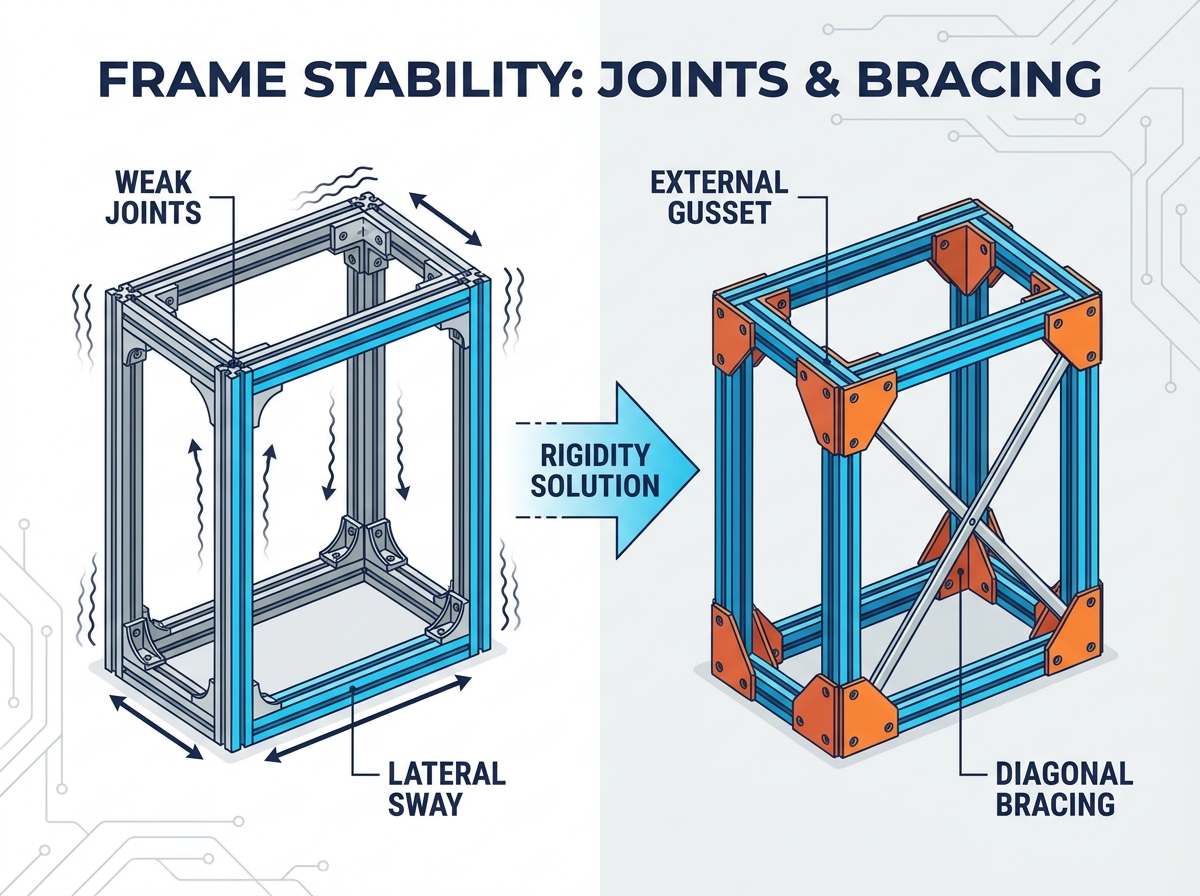
Structural instability in T-slot or V-slot assemblies is rarely a failure of the aluminum material itself. Instead, it is usually a symptom of misaligned assembly, inadequate joint selection, or unmitigated shear forces. You might build a frame expecting absolute rigidity, only to find it sways at the slightest touch.
Unwanted movement like flex, deflection, or wobble compromises precision in CNC machines. It also reduces immersion in simulator rigs and poses serious safety risks in industrial automation setups. A shifting structure fundamentally ruins the accuracy of any attached mechanical components.
Eliminating an aluminum profile frame wobble requires moving beyond basic corner brackets. You must evaluate torsional rigidity, install proper diagonal bracing, and verify assembly squareness. This guide breaks down exactly how to transform a wobbly structure into a rock-solid foundation.
Key Takeaways
Joint selection dictates rigidity: Relying solely on standard interior corner brackets is the most common cause of frame sway; external gussets and anchor fasteners provide vastly superior load distribution.
Profile size isn't a cure-all: Upgrading from a 4040 to an 8080 profile will not cure wobble if the joints acting as the pivot points remain weak.
Shear forces demand triangulation: Rectangular frames lack inherent shear resistance; introducing 45-degree corner braces or tensioned panels is mandatory for dynamic load environments.
Assembly sequence matters: Tightening fasteners before achieving perfect squareness locks in tension that manifests as micro-wobbles under operating loads.
The Physics Behind Aluminum Profile Frame Wobble
To eliminate structural instability, we must first understand how forces interact across a modular frame. Movement rarely happens in just one direction. Identifying the specific type of flex points you toward the correct hardware solution.
Understanding Torsional vs. Lateral Flex
You must distinguish between twisting and swaying. Torsional flex happens when a profile twists along its longitudinal axis. This usually occurs under heavy offset loads. Lateral flex is different. It happens when the entire frame parallelograms under side loads. Pushing against the side of a poorly braced rectangle demonstrates lateral flex. Addressing torsion requires thicker profiles. Addressing lateral flex requires better joints and triangulation.
Tolerance Stacking
Tolerance stacking is a silent killer in modular framing. Microscopic gaps exist between T-nuts, bolts, and the profile channel. A single joint might shift by a fraction of a millimeter. However, these tiny shifts multiply across multiple connections. Ten weak joints create a massive macro-movement at the top of the frame.
Static vs. Dynamic Loads
Frame requirements change drastically based on load types. Evaluate your build using these criteria:
Static Loads: A stationary workbench simply holds gravity-bound weight. Simple brackets often suffice.
Harmonic Vibrations: 3D printers and CNC routers generate constant micro-vibrations. These forces slowly loosen standard T-nuts.
Dynamic Directional Changes: Sim racing rigs experience violent force feedback. Linear actuators introduce aggressive start-stop inertia. These demand heavy-duty anchoring.
The "False Wobble" Variable
Always rule out external factors before tearing apart your frame. Uneven flooring is a common culprit. Inadequate leveling feet or cheap swivel casters easily deceive you. A perfectly rigid frame will still rock if its feet do not sit flat. Use adjustable rubber isolation feet to neutralize floor variations.
Evaluating Joint Solutions for Aluminum Extrusion Profiles
The joints are the true pivot points of any structure. When you connect aluminum extrusion profiles, the connection hardware bears the brunt of the load. Choosing the wrong fastener guarantees a wobbly frame.
Hidden Joints (Anchor/Blind Fasteners)
Anchor fasteners provide incredibly clean aesthetics. They hide entirely inside the profile channel. When milled properly, they are highly rigid. However, they require precise machining, such as tapping and drilling. They are notoriously unforgiving of assembly errors. If you drill a hole one millimeter off, the entire joint misaligns.
Standard Interior Corner Brackets (Cast vs. Machined)
Builders often default to standard interior corner brackets. You should avoid using them as the primary joint for high-vibration applications. They are susceptible to slipping under high torque. Cast brackets are particularly fragile. They can shatter under severe impact. Machined brackets are stronger but still lack sufficient surface area for dynamic loads.
External Joining Plates (Gussets)
External joining plates, or gussets, are structural lifesavers. They offer superior surface area contact. They distribute clamping force across multiple T-nuts.
Best Practice: Always evaluate the thickness of the plate and the material grade relative to the expected load. A 2mm aluminum plate flexes easily. A 6mm steel gusset locks the joint down completely.
Trust/Cost Trade-off
Over-engineering every joint adds unnecessary weight and cost. Massive gussets are expensive. Specify heavy-duty joints only at critical load-bearing intersections. Use simpler hardware for non-critical supports like monitor mounts or shelving.
Joint Solution Comparison Matrix
Joint Type
Rigidity Level
Vibration Resistance
Ideal Application
Interior Corner Bracket
Low
Poor
Static light shelving, enclosures
Blind/Anchor Fastener
High
Good
Clean-room frames, display cases
External Gusset Plate
Very High
Excellent
CNC bases, robotic cells, sim rigs
Triangulation and Bracing in an Industrial Aluminum Profile
A heavy-duty industrial aluminum profile resists bending on its own. However, configuring them into empty squares creates structural vulnerabilities. You must introduce triangulation.
The Parallelogram Problem
Simple 90-degree joints inherently struggle against lateral shear forces. Push the side of a square frame, and it naturally wants to collapse into a diamond shape. No amount of bolt-tightening completely stops a pure square from parallelogramming under heavy dynamic stress.
45-Degree Corner Braces
Inserting diagonal supports at critical junctions mathematically changes the load path. It shifts the stress away from the joint hardware. Instead, the force transfers into the axial strength of the aluminum extrusion itself.
Follow these steps to implement effective 45-degree bracing:
Identify the direction of the highest lateral force.
Select braces that span at least 15% of the adjacent profile length.
Install the brace using roll-in spring T-nuts to prevent slipping.
Tighten the main corner joint first, then lock down the diagonal brace.
Shear Panels
Using rigid materials creates a torsion box effect. You can bolt polycarbonate, aluminum sheet, or thick plywood directly into the profile channels. A solid back panel effectively eliminates side-to-side sway. The panel absorbs the shear forces, allowing the frame to act as one monolithic block.
Implementation Risk
Ensure your diagonal braces are perfectly symmetrical. Asymmetrical bracing can introduce uneven tension. Over time, this uneven stress causes the frame to warp. A warped frame leads to misaligned linear rails and binding mechanical parts.
Squareness, Fastener Preload, and Assembly Realities
Premium hardware cannot save a poorly assembled frame. The assembly process dictates the final structural integrity. Rushing the tightening phase locks in tension.
The Assembly Sequence
Never tighten bolts completely upon insertion. You must start with a "finger tight" assembly. Follow this by placing the frame on a perfectly flat reference surface. Only then should you begin sequential cross-tightening. Tightening opposite corners gradually pulls the frame into alignment. Tightening one side completely before starting the other guarantees a warped structure.
Fastener Preload and Creep
Aluminum is a relatively soft metal. It can yield slightly under constant bolt pressure. This phenomenon is known as material creep. Over several months, initially tight bolts might loosen just enough to induce wobble.
Common Mistake: Ignoring vibration in dynamic frames.
Solution: Use spring washers, such as Belleville washers, to maintain constant tension. Alternatively, apply a medium-strength threadlocker like Loctite Blue. These additions combat thermal cycling and harmonic vibrations perfectly.
Verifying Squareness
Do not rely solely on a standard carpenter's square. Extrusions can have minor surface imperfections. Instead, measure the corner-to-corner diagonals of your frame. If the top-left to bottom-right measurement matches the top-right to bottom-left measurement exactly, your frame is perfectly square. Lock down the fasteners only after verifying these measurements.
Specifying Components: A Decision Framework for Buyers
Buying aluminum extrusions and hardware requires strategic budgeting. Throwing money at massive profiles rarely solves fundamental design flaws.
Assess the Load Profile
Categorize your project before ordering parts. Are you building a static storage rack? Standard brackets will suffice. Are you building a high-torque robotic cell? You need heavy-duty gussets and vibration-resistant hardware. Determine your baseline joint requirements first.
Cost vs. Rigidity Matrix Chart
Investment Strategy
Component Focus
Rigidity Outcome
Cost Impact
Oversized Profiles
Upgrading 4040 to 8080
Moderate (Joints still weak)
Very High
Upgraded Hardware
Steel Gussets & Spring Nuts
Very High
Low to Moderate
Triangulation
Adding 45-degree braces
Excellent
Low
Shortlisting Logic
When evaluating suppliers, look for documented engineering data. Do they provide torque specifications for their T-nuts and brackets? Do not just look at theoretical extrusion load capacities. A reputable supplier knows the shear strength of their fasteners. Choose vendors who offer CAD files and extensive hardware ecosystems.
Next Steps
Audit your current design for unbraced rectangles. Identify the top three intersections bearing the highest dynamic load. Earmark these specific locations for joint upgrades. Replace interior brackets with thick external joining plates.
Conclusion
Frame wobble is a solvable geometry and hardware problem. It is never an inherent flaw of aluminum extrusions. By understanding load paths and structural limits, you can engineer absolute stability.
Upgrade your connection methods from simple brackets to external gussets for dynamic loads.
Enforce strict squareness during assembly and use cross-measuring techniques.
Apply strategic triangulation to combat parallelogramming and shear forces.
Utilize threadlocker and spring washers to defeat fastener creep over time.
Take action on your next build. Review your fastener torque specs before ordering. Incorporate external gusset plates into your CAD drawings. Consult with a structural component supplier to optimize your hardware choices and ensure a rigid, industrial-grade structure.
FAQ
Q: Does upgrading to a heavier aluminum profile stop frame wobble?
A: Not necessarily. A heavier profile resists bending along its length, but if the joints connecting the profiles are weak, the frame will still sway. Rigidity is primarily dictated by joint strength and bracing.
Q: Can I fix a wobbly frame without completely rebuilding it?
A: Yes. You can retrofit external gusset plates over existing joints, add 45-degree diagonal supports, or bolt a structural back panel to the frame to drastically reduce lateral movement.
Q: Why do my T-nuts keep loosening over time?
A: Constant vibration can cause standard T-nuts to back out. Use threadlocker, spring washers, or upgrade to roll-in spring T-nuts that maintain constant pressure against the profile channel.
Q: Are casters causing my frame to feel unstable?
A: Frequently, yes. Standard swivel casters have inherent play. For rigid applications requiring mobility, evaluate leveling casters that allow you to retract the wheel and deploy a solid, adjustable rubber foot.
We do research and trends of each country to give you the best possible product that will sell in your country. We have been the gold supplier of International Committee Red Cross since 2012.