Few things kill outdoor morale faster than a collapsed shelter in a downpour. You spend hours meticulously setting up your camp, only to watch it crumble when the wind picks up. When a telescopic pole unexpectedly gives way, your defense against the elements instantly vanishes. This sudden gear failure compromises your personal safety. It ruins otherwise perfect outdoor experiences and leaves your equipment soaked. It also forces you to spend hard-earned money on premature replacement costs. Understanding the real reason behind this issue saves both time and frustration. We will explore the exact mechanical and environmental factors causing this frustrating problem. You will learn how to separate basic setup errors from actual hardware failures. We will also evaluate the physical limits of different locking mechanisms. By the end, you will have a clear, objective framework. This guide will help you choose a reliable replacement for your shelter system.
Key Takeaways
Slippage is primarily caused by either compromised friction in twist-lock mechanisms (due to grit or wear) or improper guyline tensioning angles.
Evaluating an adjustable aluminum tarp pole requires analyzing the locking mechanism (twist, cam-lever, or push-button) against your specific load capacity and environmental needs.
High-quality aluminum tent tubing relies on specific wall thickness tolerances to prevent the flexing that leads to locking mechanism failure.
Upgrading gear should be based on verifiable payload ratings and mechanism serviceability, not just overall weight savings.
Diagnosing the Root Cause of Telescopic Tarp Pole Slipping
How do we stop a sudden shelter collapse? First, you must diagnose the exact failure point. Telescopic poles generally handle static loads quite well. A static load represents the continuous, resting weight of your tarp material. However, dynamic loads change the entire equation. Wind gusts, shifting snow, and pooling rain create sudden, violent force spikes. These dynamic spikes push the internal locking mechanisms far past their intended holding limits.
Environmental contamination plays a massive role in hardware degradation. Microscopic sand, dried salt spray, or fine trail dirt often works its way inside the pole joints. This debris aggressively degrades the internal friction collars of standard twist-lock poles. When microscopic grit coats these expanding surfaces, the friction coefficient drops drastically. When saltwater dries, the salt crystallizes and physically expands. This expansion acts like sandpaper against the plastic components. The pole simply cannot grip its inner wall securely, leading to sudden failure.
Next, consider load exceedance. Campers often underestimate the sheer weight of pooling rainwater. A seemingly small basin of water caught in your canopy can weigh dozens of pounds. Severe wind shear amplifies this stress by yanking the fabric erratically. These combined forces easily exceed the manufacturer's stated vertical load limit. This overwhelming pressure is the primary culprit behind telescopic tarp pole slipping.
Finally, material fatigue ruins gear over a long period. Campers frequently over-tighten twist locks to compensate for older, worn-out poles. This extreme twisting pressure permanently warps the internal plastic expanding cones. Once those internal plastic cones deform, they lose their structural memory. They will never grip the metal tubing properly again. The damage becomes permanent.
Evaluating Locking Mechanisms: Security vs. Usability
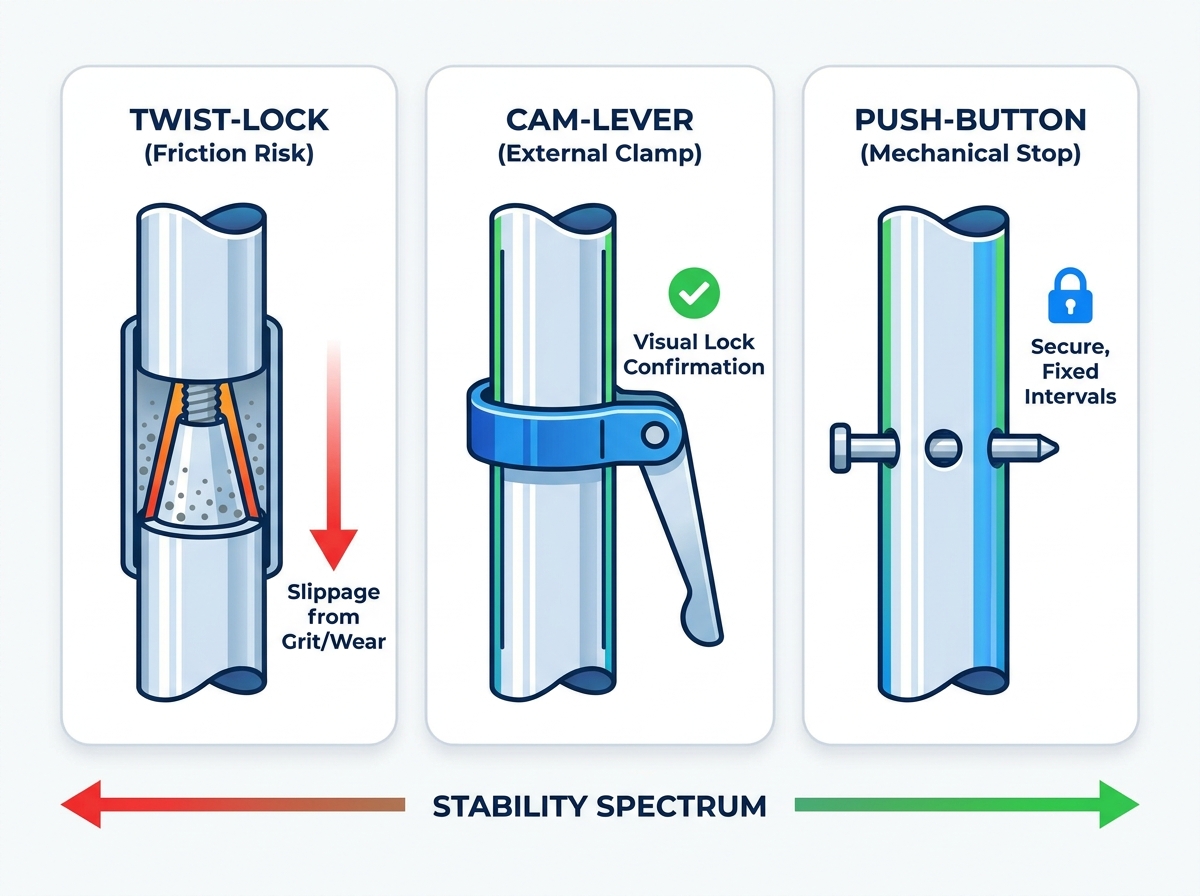
Hardware design ultimately dictates field reliability. We categorize shelter supports by their fundamental locking frameworks. The outdoor industry relies on three main engineering solutions. You must carefully weigh ultimate security against practical field usability.
Twist-Lock (Friction)
Twist-locks use an internal expanding plastic mechanism to secure the height.
Pros: They offer infinite height adjustment capabilities. You can set them to any micro-millimeter height required. Their smooth, streamlined profile prevents them from snagging on delicate tent fabric.
Risks: They unfortunately have the highest susceptibility to slipping. When they get wet, frozen, or dirty, the required internal friction disappears. They are also incredibly difficult to tension properly if you have cold, wet hands during a storm.
Cam-Lever Lock (External Clamping)
These use an external flip-lever to clamp the outer tube against the inner tube.
Pros: You get instant visual confirmation of the lock status. If the lever points down, the pole is locked securely. They remain easy to field-adjust while wearing thick gloves. They are significantly less vulnerable to internal grit destroying the mechanism.
Risks: The protruding external levers can easily snag on guylines or packing bags. The small tension screws holding the lever may require periodic field calibration using a screwdriver to maintain holding power.
Push-Button / Detent Pin (Mechanical Stop)
These use a spring-loaded steel pin popping through pre-drilled holes in the shaft.
Pros: They offer the absolute highest load security available today. It remains physically impossible for the pole to collapse under weight unless the solid steel pin actually shears off.
Risks: They only offer fixed interval adjustments, usually every two inches. This design limits precise pitch tuning on highly uneven ground.
Table 1: Locking Mechanism Comparison Matrix
Mechanism Type
Primary Advantage
Major Vulnerability
Best Environment
Twist-Lock
Infinite adjustability
Friction loss when wet
Fair-weather, lightweight setups
Cam-Lever Lock
Visual lock confirmation
Snagging hazard
Sandy, muddy, or freezing conditions
Push-Button
Fail-proof mechanical stop
Fixed height intervals
Heavy canvas and extreme winds
The Role of Material Tolerances in Aluminum Tent Tubing
Robust locking mechanisms mean absolutely nothing if the metal tubing fails. Your overall shelter stability relies heavily on strict material tolerances. We must evaluate how the structural tubing specifications dictate real-world field outcomes.
Wall thickness directly controls shaft flex. Thin-walled tubes bow significantly under heavy guyline tension. When a pole bows, the inner tubular geometry shifts dramatically. A bowing pole creates a dangerous lever arm effect. This mechanical disadvantage multiplies the stress on the weakest point of the lock. This sudden bowing changes the contact angle of the internal locking mechanism. An altered angle reduces the vital surface contact area, directly causing dangerous slippage. Upgrading to high-quality aluminum tent tubing prevents this destructive bending force. Thick walls maintain perfect linear alignment under immense stress.
You must also pay close attention to specific tubing grades. Standard 6000-series aluminum alloys offer decent baseline corrosion resistance and high affordability. They work well for casual weekend camping. However, aircraft-grade 7000-series aluminum provides vastly superior yield strength. The 7000-series alloy handles massive, sustained weight-bearing capacity without permanently bending or snapping.
Finally, anodization quality matters greatly for external clamping locks. A smooth, high-gloss anodized surface looks fantastic on the shelf but severely reduces the friction coefficient. Matte, brushed, or micro-textured anodized finishes provide a vastly better gripping surface. This rougher texture helps external cam-lever locks bite into the metal and hold tight during severe weather events.
Setup Checks: Mitigating Implementation Risks
Before blaming your expensive hardware, audit your physical implementation. Basic user error accounts for a massive percentage of collapsed shelters. We highly recommend verifying these structural best practices during every single setup.
First, rigorously assess your guyline geometry. Pitch angles dictate total force distribution across the canopy. Guylines pulling at shallow angles less than 45 degrees create immense lateral sheer force on the upright shaft. This sideways pull aggressively accelerates downward pole slippage. Always stake your lines at steep, supportive angles to drive the kinetic force straight down into the earth.
Next, verify your base footprint stability. Closely check the ground composition directly under the pole foot. Soft mud, loose beach sand, or deep snow causes the base to sink slowly. Sinking immediately alters your rigid line tension. When system tension drops, mechanical locks easily disengage or shift entirely out of alignment. Use a wide footprint base attachment or place a wide, flat rock under the pole to stop sinking.
Lastly, establish strict baseline maintenance protocols. Regular field maintenance extends your gear life significantly.
Flush the internal tubes vigorously with clean, fresh water after every coastal trip.
Brush out any visible dirt or grit from the locking collars using a stiff nylon brush.
Inspect your guyline cordage for excessive stretch. Stretchy nylon cords lose tension overnight, mimicking pole slippage.
Dry the poles fully before storing them in a dark closet to prevent oxidation.
Never apply chemical lubricants to the joints. Lubrication completely destroys the static friction needed to hold the pole up.
Shortlisting an Adjustable Aluminum Tarp Pole: Buyer’s Framework
What happens when a pole becomes truly mechanically compromised? You need strict criteria for evaluating new replacements. Follow this step-by-step shortlisting logic to find a reliable, long-lasting upgrade.
Define Peak Load Requirements: Match the maximum vertical load rating to your specific tarp size. Larger surface areas act like giant ship sails catching the wind. You must also factor in your expected regional wind conditions. We assume no standard pole survives a Category 5 hurricane. However, appropriately sizing your gear prevents standard thunderstorm failure. An adjustable aluminum tarp pole should comfortably exceed your highest peak load estimate by at least thirty percent.
Ensure Mechanism Alignment: Match the lock design directly to your primary environment. Choose external cam-levers for sandy or muddy environments where airborne grit remains unavoidable. Select robust push-button systems for heavy canvas shelters, large group tarps, or severe winter snow loads. Reserve internal twist-locks exclusively for lightweight, fair-weather hiking setups where ounce-counting matters most.
Prioritize Long-Term Serviceability: Prioritize gear you can actually fix in the backcountry. Buy from reputable brands selling replacement locking components directly to consumers. You want easy access to spare levers, tension screws, or replacement detent pins. Avoid heavily sealed, disposable hardware units. If a sealed unit breaks on the trail, you must throw the entire pole away.
Conclusion
Diagnosing sudden shelter failures requires a calm, systematic approach. You should check your guyline setup angles first to ensure proper downward force. Next, clean the locking mechanisms thoroughly to restore lost grip. Finally, replace the entire unit if the internal expanding components are permanently warped or cracked.
Investing in appropriate, thick-walled tubing and robust locking mechanisms always pays off. High-quality gear dramatically reduces your long-term replacement costs. It also guarantees absolute peace of mind during severe weather outbreaks.
Audit your current shelter poles for excessive wear today. Check the locking collars closely and test the load tension before your next backcountry deployment. If your gear falls short, upgrade immediately based on your true environmental payload requirements.
FAQ
Q: Can a slipping twist-lock tarp pole be repaired?
A: You can often repair it if the issue involves mere dirt buildup. Disassemble the sections completely, flush them with fresh water, and scrub the plastic expanding cone. However, if the plastic threading is irreparably stripped or cracked from repeated over-tightening, it cannot be fixed. At that point, you must replace the damaged pole.
Q: Are carbon fiber poles more slip-resistant than aluminum?
A: Carbon fiber is significantly lighter but not inherently more slip-resistant. Carbon fiber flexes differently and can easily crack under extreme external clamping pressure. Aluminum offers a distinct durability advantage. It easily withstands the heavy, localized clamping force required for secure cam-lever locks without shattering.
Q: How much weight should a heavy-duty tarp pole support?
A: A reliable heavy-duty pole should comfortably support a realistic baseline of 50 to 100+ lbs of direct vertical pressure. This capacity depends entirely on the chosen locking mechanism. Push-button locks easily handle the higher end of this spectrum. Standard friction-based twist-locks usually max out much earlier.
Q: Should I lubricate tarp pole locks to prevent sticking?
A: No, you should strictly avoid applying any lubrication. Chemical lubricants completely eliminate internal friction. Twist-locks and cam-levers rely entirely on static friction to hold the extended sections firmly in place. If you grease the joints, the pole will immediately collapse under the slightest load.
We do research and trends of each country to give you the best possible product that will sell in your country. We have been the gold supplier of International Committee Red Cross since 2012.