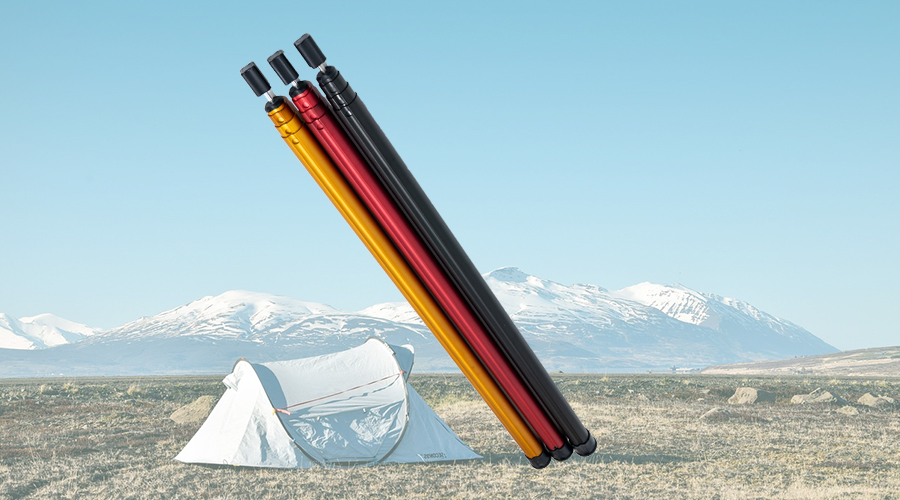
Structural failure in commercial, glamping, or heavy-duty wall tents rarely stems from the fabric. It originates from under-specified frame mechanics. When high winds hit a broad canvas wall, the load transfers directly to the metal skeleton. If those poles lack the proper rigidity, the entire structure collapses.
Buyers and fabricators must balance load-bearing capacity against logistical realities. You need frames strong enough to handle heavy snow and thick canvas weight. However, you also must manage transport weight, section length, assembly fatigue, and material costs. Guessing on dimensions leads to catastrophic buckling or unnecessary expenditure on overbuilt frames.
Moving from trial-and-error to a calculated approach requires understanding the physics of deflection. You must evaluate alloy strength and the precise relationship between outer diameter, wall thickness, and joint placement. Selecting the right tent tubing ensures your structures remain standing through severe weather while remaining practical to transport and assemble.
Key Takeaways
Diameter Dictates Stiffness: Increasing the outer diameter of a tube provides a higher resistance to bending (deflection) than simply increasing the wall thickness, often at a lower weight penalty.
Wall Thickness Prevents Localized Failure: Thicker walls are critical for resisting crushing forces at joint connections, preventing dents from impact, and supporting hardware like pins and brackets.
Section Length and Joint Frequency Matter: More joints mean more potential points of failure; balancing transportable section lengths with structural continuity is essential.
Alloy Matters as Much as Dimensions: A 2-inch diameter tube extruded from 6061-T6 aluminum will perform drastically differently under load than the same dimensions in a softer 6063 alloy.
System Compatibility is Non-Negotiable: Tubing dimensions must precisely align with standardized commercial fittings (e.g., slip-fit connectors, west coast frame hardware) to ensure structural stability.
Establishing Baseline Success Criteria for Tent Frames
Before selecting any metal dimensions, you must define the forces your structure will face in the field. Every tent frame acts as a load-bearing skeleton. It must resist dynamic lateral forces from wind and static vertical forces from snow, ice, or heavy rain. Ignoring these baseline metrics guarantees a collapsed frame during the first major weather event.
Defining Environmental Loads
Dynamic wind loads apply immense pressure to the broad side of a tent. A 40-mph wind gust creates significant lateral force that attempts to bend upright poles and shear corner joints. As wind speed doubles, the force exerted on the tent quadruples. You must calculate the required resistance to keep the frame rigid. Static snow loads apply vertical downward force. Snow accumulation on a low-pitch roof can easily exceed hundreds of pounds. Wet snow weighs roughly 20 pounds per cubic foot. The rafters and ridge poles must support this weight without bowing. You must evaluate the local climate conditions where the structure will deploy to establish baseline strength requirements.
Span Length and Unsupported Sections
The distance between vertical uprights or rafters exponentially increases the required stiffness of the tubing. A ten-foot unsupported ridge pole will sag much faster than a five-foot section under the exact same load. Long spans require significantly higher rigidity to prevent deflection. When designing a frame, you must identify the longest unsupported sections. These critical spans dictate the minimum outer diameter required for the entire roof structure. Shortening spans by adding more rafters reduces the load on individual tubes but increases the overall part count, transport volume, and assembly time.
Fabric Weight and Tension
The frame must support the dead weight of the tent material. Heavy 12oz treated canvas weighs substantially more than lighter PVC vinyl or nylon. When wet, canvas absorbs moisture and becomes even heavier, sometimes doubling in weight. You must factor in this dead weight when sizing rafters and uprights. Proper tent setup requires high fabric tension to prevent water pooling. Water pooling creates massive localized weight that can snap thin-walled poles in minutes. The frame must possess enough structural integrity to hold tight tension across the fabric without bowing inward.
Footprint-to-Frame Ratios and Layout Examples
Industry baselines help determine the overall scale of the structure. A standard guideline suggests 20 to 25 square feet per person for comfortable occupancy. Mapping out specific layout examples dictates the necessary frame load and upright distribution. A 4-person hunting layout requires a relatively small footprint. You can utilize lighter tubing with fewer uprights. Conversely, a 50-person event layout demands a massive footprint. This requires heavy-duty commercial tubing, frequent uprights, and potentially double-tube rafters to support the expansive roof area safely.
Baseline Load Considerations for Tent Frames
Load Type
Source
Primary Impact on Frame
Engineering Countermeasure
Dynamic Lateral
Wind gusts, severe storms
Bends uprights, shears corner fittings
Increase outer diameter, add cross-bracing
Static Vertical
Snow, ice, heavy rain pooling
Sags rafters, bows ridge poles
Shorten unsupported spans, increase diameter
Dead Weight
Wet canvas, heavy vinyl tops
Constant downward pressure on all joints
Use high yield strength alloys (6061-T6)
Tension Load
Ratchet straps, guy lines
Compresses the frame inward
Increase wall thickness at connection points
The Physics of Tent Tubing: Diameter vs. Wall Thickness
Understanding how metal behaves under stress prevents structural failure. Many builders mistakenly believe that thicker walls automatically create stronger poles. While wall thickness matters, outer diameter plays a far more significant role in preventing a pole from bending under heavy loads.
Understanding the Moment of Inertia
The moment of inertia measures an object's resistance to bending. In tubular structures, moving material further from the center axis increases rigidity exponentially. A larger outer diameter spreads the load over a wider cross-section. This makes the tube significantly stiffer than a smaller diameter tube with a thicker wall. If you want to stop a long rafter from sagging, increasing the diameter is the most efficient engineering choice. Jumping from a 1.5-inch outer diameter to a 2-inch outer diameter nearly doubles the stiffness of the pole, providing massive gains in rigidity with a minimal increase in overall weight.
The Role of Wall Thickness
While diameter dictates stiffness, wall thickness prevents localized failure. Thin walls crush easily under pressure. Evaluating how wall thickness contributes to hoop strength is mandatory for safe frame design. Hoop strength keeps the tube round under compressive loads, such as when a heavy bracket clamps around the pole. Thicker walls provide dent resistance during transport and rough handling by setup crews. Most importantly, adequate wall thickness prevents tear-out at drilled pin-holes. When you drill a hole for a fastener, you remove material and create a weak point. A thicker wall ensures enough metal remains to support the pin without ripping under tension.
Section Length Dynamics
Every joint in a tent frame introduces a potential weak point. The structural trade-off between long, continuous tubing and shorter, segmented poles defines the frame's reliability. Continuous tubes offer higher strength and predictable load distribution. However, ten-foot poles are difficult to transport in standard vehicles and require dedicated trailers. Segmented poles are easier to transport but carry a higher risk of joint deflection. When using segmented poles, the internal sleeve or external connector must fit tightly. Any play in the joint allows the frame to flex, which compounds across multiple connections and weakens the entire structure.
The Weight-to-Strength Trade-off
Optimizing a frame requires calculating the pounds-per-foot of different tubing configurations. You want maximum structural integrity with minimal transport weight. A 2-inch tube with a .065-inch wall might weigh the same as a 1.5-inch tube with a .125-inch wall. However, the 2-inch tube will resist bending far better. You must analyze these metrics to build a frame that field crews can actually lift and assemble without risking collapse during a storm.
Comparison of Tubing Characteristics
Tubing Characteristic
Primary Benefit
Primary Drawback
Best Application
Large Outer Diameter (OD)
Maximum resistance to bending and deflection
Takes up more storage space
Long unsupported roof spans and rafters
Thick Wall
High crush resistance and strong fastener support
Heavier weight per foot
High-stress corner joints and base plates
Continuous Length
Unbroken structural integrity
Difficult to transport and ship
Permanent or semi-permanent installations
Segmented Length
Easy transport and modular setup
Joints create weak points and flex
Portable base camps and temporary events
Aluminum Tent Pole Sizing Guide: Standard Dimensions and Applications
Selecting the right dimensions requires matching the metal to the specific application. Using a comprehensive aluminum tent pole sizing guide helps you avoid both overbuilding and under-specifying your frame. Different tent styles demand entirely different structural approaches.
Light-to-Medium Duty (Recreational, Glamping, and Base Camps)
For standard recreational setups, extreme heavy-duty metal adds unnecessary weight and complicates assembly. Standard OD ranges typically fall between 1 inch and 1.25 inches. Standard wall thicknesses usually range from .049 inches to .065 inches. These dimensions provide excellent strength for smaller footprints. Best use cases include standard canvas wall tents, internal frame hunting tents, and temporary shade structures. They also work perfectly for long-term scout or base camp setups, such as traditional Philmont-style wall tents. These sizes balance portability with enough rigidity to handle moderate wind and rain without bending.
Heavy-Duty and Commercial Frame Tents
Commercial structures demand robust engineering. Evaluating standard commercial dimensions reveals a heavy reliance on larger profiles. The ubiquitous 2-inch diameter single tube serves as the industry standard for most medium commercial tents. For massive spans, builders upgrade to heavy-duty 2-inch by 4-inch double tube clear, anodized aluminum pipe. Wall thickness requirements for commercial rental fleets typically sit at .125 inches (1/8-inch). This thickness withstands repeated assembly abuse, rough transport, and high-stress mechanical fasteners. Rental inventory takes a beating, and thin walls simply will not survive the constant handling by setup crews.
Adjustable Aluminum Tarp Pole Specifications
Telescoping poles offer incredible versatility for custom awnings, rain flys, and uneven terrain. When designing an adjustable aluminum tarp pole, telescoping mechanics require precise sizing. You must size the inner and outer tubes to ensure a tight friction fit without binding. A clearance of roughly .010 to .015 inches allows smooth operation while preventing wobble. Overlap requirements are critical for safety. You must calculate the minimum insertion depth required to prevent snapping at full extension. A standard rule requires at least six inches of internal overlap when fully extended to maintain joint rigidity and prevent the inner tube from levering against the outer wall and cracking it.
Material Selection: Alloys and Extrusion Types
The physical dimensions of a tube mean nothing if the underlying metal lacks strength. Aluminum comes in various alloys, each engineered for specific mechanical properties. Choosing the wrong alloy guarantees structural failure regardless of the wall thickness or outer diameter.
6061-T6 vs. 6063 Aluminum
The structural standard for load-bearing frames is 6061-T6 aluminum. It offers a high yield strength of roughly 35,000 psi. It handles bending forces exceptionally well and machines cleanly for drilling. Conversely, 6063 aluminum is an architectural grade. It extrudes easily and polishes well, but it possesses significantly lower yield strength, often hovering around 21,000 psi. A tent frame built from 6063 will bend permanently under loads that a 6061-T6 frame would easily shrug off. Always verify that your supplier provides 6061-T6 for any structural tent application.
The Importance of Anodizing
Raw aluminum oxidizes quickly when exposed to the elements. This oxidation creates a dark, powdery residue on the metal surface. Clear anodized finishes are critical for preventing this aluminum oxidation. Anodizing hardens the outer surface, reducing friction at slip joints and making assembly much easier. More importantly, it keeps tent fabric clean. Without anodizing, the raw aluminum oxide transfers directly onto white canvas or vinyl, leaving permanent black streaks that ruin the appearance of expensive tent materials.
Aluminum vs. Galvanized Steel
While aluminum dominates the portable tent industry, steel has its place. You must apply a comparative lens on when to abandon aluminum entirely in favor of galvanized steel. Permanent structures facing extreme snow loads often require steel. Steel offers massive yield strength and rigidity that aluminum cannot match without becoming prohibitively large. However, steel carries a severe weight penalty. It is roughly three times heavier than aluminum. It is difficult to transport, hard to assemble without machinery, and prone to rust if the galvanization scratches. Reserve steel for permanent installations where portability is no longer a factor.
Evaluating Joint Fit, Connectors, and Hardware Compatibility
A tent frame is only as strong as its weakest connection. The points where tubes meet endure the highest stress concentrations. Proper engineering at these junctions ensures the frame acts as a unified structure rather than a collection of loose parts.
Tolerance Stacking
Extruded aluminum has manufacturing tolerances. Slight variations in extruded wall thickness can ruin the fit of internal slip-joints or external corner brackets. If a tube runs slightly oversized and a fitting runs slightly undersized, they will not slide together in the field. Conversely, too much clearance creates a sloppy joint that flexes under wind loads. You must account for tolerance stacking when ordering materials. Specify exact outer and inner diameter tolerances with your supplier to ensure a perfect slip fit every time.
Standardized Fittings
Building a frame with proprietary dimensions locks you into a single supplier. The necessity of choosing tubing dimensions that match readily available commercial hardware cannot be overstated. Industry-standard West Coast style fittings rely on specific outer diameters, typically 1.5-inch or 2-inch. Using standardized tubing allows you to source replacement corner brackets, base plates, and ridge fittings from multiple vendors. It simplifies inventory management and ensures you can always find compatible parts during an emergency repair.
Position of Joining Features
Fastening tubes together requires drilling holes for pins or bolts. The engineering behind where holes are drilled dictates joint strength. Drilling a hole too close to the end of a tube invites tear-out under tension. Improper placement creates stress concentrations that lead to tube fracturing under load. Holes should be centered accurately and placed far enough from the tube edge to maintain structural integrity. A standard field rule requires an edge distance of at least two times the hole diameter. Clean, deburred holes prevent micro-cracks from forming during the drilling process.
Fastener Integration
The hardware you use must match the metal's capabilities. Sizing wall thickness to safely accommodate through-bolts, detent pins, and spring buttons is vital. A thin-walled tube will crush if you over-tighten a through-bolt. It will also deform if a spring button bears the full weight of a heavy canvas roof. Ensure the wall thickness at connection points provides enough bearing surface for the fastener to distribute the load without warping the aluminum.
Implementation Risks: Where Tent Tubing Specifications Fail
Even with good intentions, buyers frequently make specification errors that compromise safety or logistics. Recognizing these common pitfalls helps you avoid costly mistakes during the procurement phase.
Over-Specifying (The Weight Trap)
Fear of collapse often leads to over-engineering. Selecting tubing that is too thick or excessively large results in a frame that is a logistical nightmare. Heavy frames require excessive labor to erect, increasing setup times and fatiguing crews. Furthermore, heavy metal increases shipping costs unnecessarily. A massive frame might survive a hurricane, but if it takes four people to lift a single rafter, it is entirely impractical for daily rental operations or weekend camping trips.
Under-Specifying (The Deflection Risk)
Budget constraints frequently push buyers toward thinner, cheaper metal. Choosing thin-walled or narrow-diameter tubing to save money is a dangerous gamble. This leads to catastrophic buckling under sudden wind gusts or heavy rain pooling. When a main upright buckles, the entire tent collapses, potentially damaging expensive equipment or injuring occupants inside. The minor cost savings achieved by buying thinner metal are instantly wiped out by the cost of a single structural failure.
Sourcing and Replacement Challenges
Using custom or proprietary tubing sizes creates long-term maintenance headaches. If a proprietary pole bends during an event, you cannot simply buy a replacement locally. The danger of using non-standard dimensions means you rely entirely on a single manufacturer for parts. Relying on standard, locally sourceable dimensions ensures you can easily replace bent poles. It keeps your tents operational and prevents downtime while waiting for custom extrusions to ship.
Galvanic Corrosion at Connection Points
Mixing dissimilar metals in an outdoor environment invites chemical reactions. The risk of galvanic corrosion occurs when you mix metals like steel pins in raw aluminum tubing without proper isolation. Moisture acts as an electrolyte, causing the aluminum to corrode rapidly around the steel fastener. This leads to seized joints that refuse to come apart after a long deployment. Proper anodization and using compatible stainless steel or coated fasteners mitigate this risk and ensure joints slide freely season after season.
Conclusion
Optimal tent tubing selection is an engineering compromise. You must balance maximum rigidity through larger diameters, durability against abuse through adequate wall thickness, and logistical feasibility regarding weight and section length. Ignoring any of these three pillars results in a compromised structure.
For commercial rentals and wide-span frames, default to a 2-inch OD or 2x4 double tubes with a minimum .125-inch wall in 6061-T6 aluminum. This provides the necessary durability for heavy use. For personal wall tents and adjustable setups, utilize 1.25-inch to 1.5-inch OD with .065-inch walls to balance strength and portability effectively.
To ensure your next frame performs flawlessly, execute these exact steps:
Measure your longest unsupported roof span to establish the baseline outer diameter requirement for your rafters.
Calculate the total weight of your canvas or vinyl top when wet to determine the static vertical loads your frame must support.
Specify 6061-T6 aluminum with a clear anodized finish on all purchase orders to prevent oxide transfer and ensure high yield strength.
Standardize your frame around 1.5-inch or 2-inch outer diameters to guarantee compatibility with off-the-shelf commercial fittings.
Implement a minimum edge distance of two times the hole diameter when drilling for detent pins to prevent metal tear-out under tension.
FAQ
Q: What is the standard diameter for commercial tent tubing?
A: The industry standard for medium-duty commercial frame tents is a 2-inch outer diameter single tube. For larger clear-span structures or areas with high environmental loads, manufacturers utilize heavy-duty 2-inch by 4-inch double tube aluminum profiles to prevent roof deflection.
Q: How does wall thickness affect the strength of an aluminum tent pole?
A: Wall thickness primarily provides crush resistance and prevents localized damage. While it adds some stiffness, its main function is to stop the tube from denting during transport, resisting the clamping force of brackets, and preventing tear-out at drilled pin holes.
Q: Which aluminum alloy is best for heavy-duty tent frames?
A: 6061-T6 aluminum is the optimal choice for structural tent frames. It possesses a high yield strength of roughly 35,000 psi, making it highly resistant to bending and snapping under load, unlike softer architectural alloys such as 6063.
Q: How do I calculate the right size for an adjustable aluminum tarp pole?
A: You must select an inner and outer tube with a tight friction fit, allowing about .010 to .015 inches of clearance. Additionally, you must factor in a minimum of six inches of internal overlap when fully extended to maintain structural rigidity.
Q: How does section length and joint placement affect tent frame strength?
A: Every joint introduces a potential weak point where flex can occur. Longer, continuous sections are structurally superior and resist bending better. However, segmented poles are necessary for transport; their joints must fit tightly to prevent cumulative deflection across the frame.
Q: Can I use steel fittings with aluminum tent tubing?
A: Yes, but you must manage the risk of galvanic corrosion. Use anodized aluminum and high-quality stainless steel or galvanized fittings. Avoid mixing raw steel with raw aluminum in wet environments, as this causes the metals to corrode and seize together.
Q: What is the difference between single tube and double tube tent frames?
A: Single tube frames use one continuous extrusion, ideal for standard spans and moderate loads. Double tube frames weld or extrude two tubes together, creating a massive increase in rigidity for wide-span commercial tents that must support heavy snow or wind loads.
We do research and trends of each country to give you the best possible product that will sell in your country. We have been the gold supplier of International Committee Red Cross since 2012.